
THE ART OF THE UNFINISHED
THE ART OF THE UNFINISHED
Objects, fragments and forms that leave something unresolved.
Art & Object
CULTURE
SPACE

INTRO
We are drawn to things that feel complete. Finished objects, perfect surfaces, precise compositions.
But there is another kind of beauty in things that remain open.
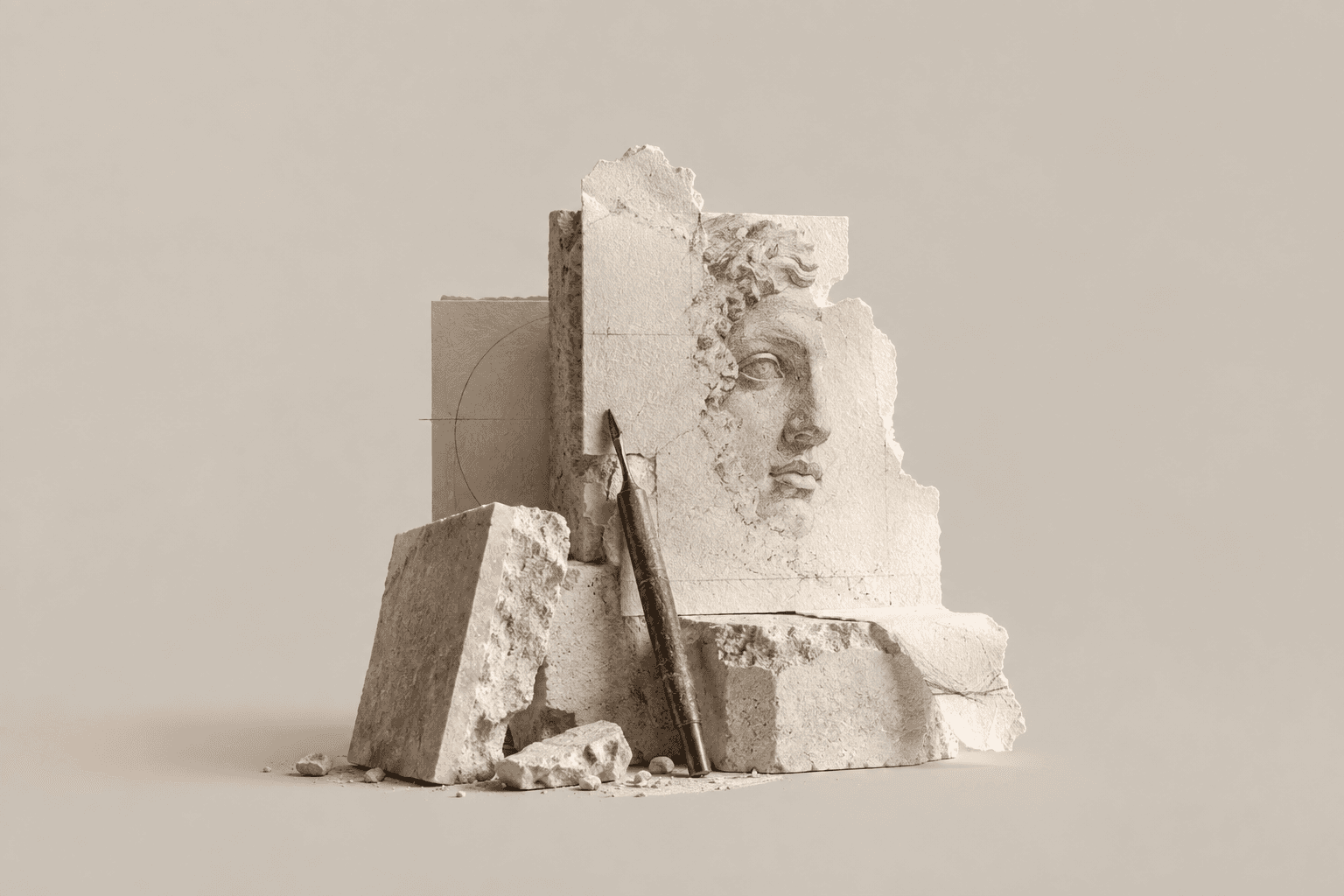
For this editorial, MASON & FORM explores the unfinished as a creative language. Through objects, materials and carefully constructed scenes, we examine what happens when the process remains visible and imperfection becomes part of the composition.
BEAUTY IN PROGRESS
An unfinished object carries the memory of what it could become.
A rough stone still suggests the sculpture hidden inside it. A piece of fabric reveals the construction behind the garment. A structure without its final surface exposes the logic beneath.
What we usually consider incomplete can become its own form of expression.
The most interesting part of an image is sometimes what has deliberately been left out.
A missing piece creates tension. An empty surface creates silence. An interrupted form invites the viewer to complete the thought.
Rather than revealing everything, the unfinished creates space for imagination.


MADE TO REMAIN OPEN
Today, perfection is easy to reproduce.
The unfinished is harder to imitate because it carries intention, process and human touch.
For this visual series, we created a collection of still-life compositions using stone, paper, metal, fabric and everyday objects. Each scene is deliberately incomplete, allowing material, shadow and negative space to become part of the story.
The result is not about unfinished work.
It is about choosing what not to finish.
THE VALUE OF WHAT REMAINS
In art, objects and visual communication, restraint can be as powerful as detail. Not every surface needs to be filled. Not every idea needs to be explained. Not every composition needs a definitive ending.
The same principle can inform how brands express themselves. A distinctive visual identity does not need to communicate everything at once. It needs a clear point of view, a sense of intention and enough space for people to engage with it.
At MASON & FORM, we approach branding and creative direction as exercises in clarity, composition and meaning. Every element has a purpose; every omission can be just as deliberate as what remains.
Sometimes, what makes a form memorable is not what has been added, but what has been left open.


THE ART OF THE UNFINISHED
Objects, fragments and forms that leave something unresolved.
Art & Object
CULTURE
SPACE
INTRO
We are drawn to things that feel complete. Finished objects, perfect surfaces, precise compositions.
But there is another kind of beauty in things that remain open.
For this editorial, MASON & FORM explores the unfinished as a creative language. Through objects, materials and carefully constructed scenes, we examine what happens when the process remains visible and imperfection becomes part of the composition.
BEAUTY IN PROGRESS
An unfinished object carries the memory of what it could become.
A rough stone still suggests the sculpture hidden inside it. A piece of fabric reveals the construction behind the garment. A structure without its final surface exposes the logic beneath.
What we usually consider incomplete can become its own form of expression.
The most interesting part of an image is sometimes what has deliberately been left out.
A missing piece creates tension. An empty surface creates silence. An interrupted form invites the viewer to complete the thought.
Rather than revealing everything, the unfinished creates space for imagination.
MADE TO REMAIN OPEN
Today, perfection is easy to reproduce.
The unfinished is harder to imitate because it carries intention, process and human touch.
For this visual series, we created a collection of still-life compositions using stone, paper, metal, fabric and everyday objects. Each scene is deliberately incomplete, allowing material, shadow and negative space to become part of the story.
The result is not about unfinished work.
It is about choosing what not to finish.
THE VALUE OF WHAT REMAINS
In art, objects and visual communication, restraint can be as powerful as detail. Not every surface needs to be filled. Not every idea needs to be explained. Not every composition needs a definitive ending.
The same principle can inform how brands express themselves. A distinctive visual identity does not need to communicate everything at once. It needs a clear point of view, a sense of intention and enough space for people to engage with it.
At MASON & FORM, we approach branding and creative direction as exercises in clarity, composition and meaning. Every element has a purpose; every omission can be just as deliberate as what remains.
Sometimes, what makes a form memorable is not what has been added, but what has been left open.
THE ART OF THE UNFINISHED
Objects, fragments and forms that leave something unresolved.
Art & Object
CULTURE
SPACE
INTRO
We are drawn to things that feel complete. Finished objects, perfect surfaces, precise compositions.
But there is another kind of beauty in things that remain open.
For this editorial, MASON & FORM explores the unfinished as a creative language. Through objects, materials and carefully constructed scenes, we examine what happens when the process remains visible and imperfection becomes part of the composition.
BEAUTY IN PROGRESS
An unfinished object carries the memory of what it could become.
A rough stone still suggests the sculpture hidden inside it. A piece of fabric reveals the construction behind the garment. A structure without its final surface exposes the logic beneath.
What we usually consider incomplete can become its own form of expression.
The most interesting part of an image is sometimes what has deliberately been left out.
A missing piece creates tension. An empty surface creates silence. An interrupted form invites the viewer to complete the thought.
Rather than revealing everything, the unfinished creates space for imagination.
MADE TO REMAIN OPEN
Today, perfection is easy to reproduce.
The unfinished is harder to imitate because it carries intention, process and human touch.
For this visual series, we created a collection of still-life compositions using stone, paper, metal, fabric and everyday objects. Each scene is deliberately incomplete, allowing material, shadow and negative space to become part of the story.
The result is not about unfinished work.
It is about choosing what not to finish.
THE VALUE OF WHAT REMAINS
In art, objects and visual communication, restraint can be as powerful as detail. Not every surface needs to be filled. Not every idea needs to be explained. Not every composition needs a definitive ending.
The same principle can inform how brands express themselves. A distinctive visual identity does not need to communicate everything at once. It needs a clear point of view, a sense of intention and enough space for people to engage with it.
At MASON & FORM, we approach branding and creative direction as exercises in clarity, composition and meaning. Every element has a purpose; every omission can be just as deliberate as what remains.
Sometimes, what makes a form memorable is not what has been added, but what has been left open.
